Most multi-company software keeps everybody's rows in one table and
filters by a company column. One missing filter in one query and
your data is in someone else's report. Orbit
does not work that way: your company gets a database of its own.
Isolation
A database per company
When you register, the platform creates a database that
belongs to your company and connects to it with your
company's own connection details. Applications you install
create their tables in there. Your records are not in a
shared table with a column naming you — they are in a
different database entirely.
The practical consequence: the most common way this class of
product leaks data — a query that forgot its
WHERE company_id = ? — cannot reach
another company's rows here, because those rows are not in
the database the query is running against.
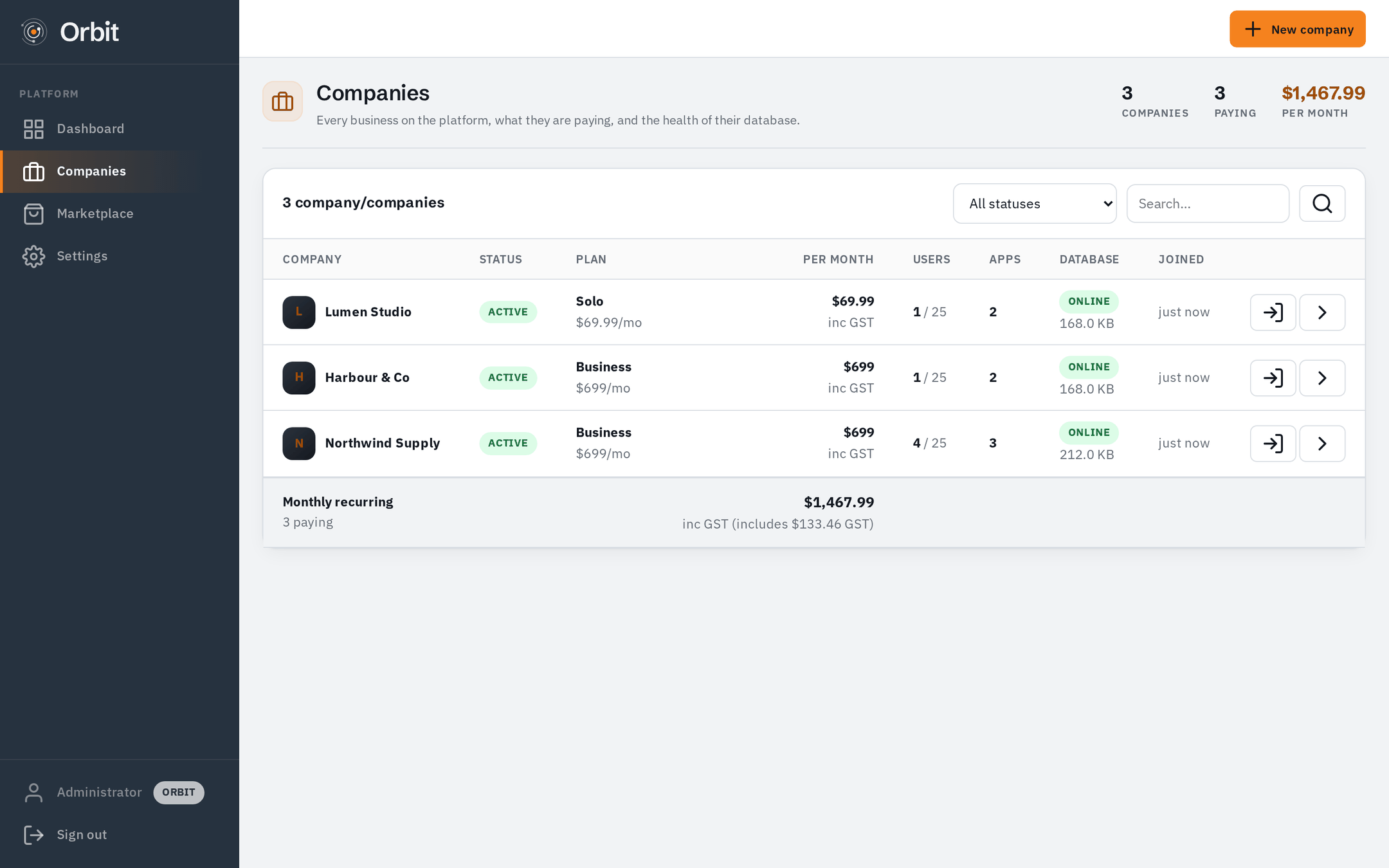
orbit.app/admin/companies
Three companies in the operator's console — and three databases.
In detail
The specifics
Numbers you can hold us to, rather than adjectives.
Passwords are never stored
Only a PBKDF2-SHA256 derivation is kept — 200,000
iterations with a fresh 16-byte random salt for every
password. Verification is a constant-time comparison, so a
wrong password cannot be narrowed down by timing it. We
cannot tell you your password because we do not have it.
Invitations expire
An invitation is a 256-bit random token. What is stored is
its SHA-256 hash, not the token, so a copy of the database
does not let anyone accept outstanding invitations. It is
valid for 14 days, and once accepted it cannot be used
again. The new starter sets their own password; nobody
types a colleague's password for them.
Password resets are short-lived
A reset link lasts 30 minutes and works exactly once
— the moment it is used it is marked used, and any
other outstanding links for that account stop working.
Reset tokens are hashed in the database just like
invitations.
Access is per person, per app
Installing an application grants nobody access to it. Your
own administrator decides who may open which app, and
roles decide who may administer the company. Remove
somebody and their access ends everywhere at once.
Hardened responses
Every response carries a content security policy, plus
nosniff, SAMEORIGIN framing, a
strict referrer policy, and a permissions policy that
switches off camera, microphone and location. Session
cookies are SameSite=Lax, and HTTPS-only
cookies with HSTS are available to the operator.
Your own audit trail
Installs, invitations, people joining and setting changes
are written to a log in your database with the
person who did it and when. It is your record, stored with
your data, and you can read it without asking us.
Updates
Updates that can be undone
An update is the riskiest thing that happens to running
software, so it is the part with the most safety rails. A
release is checksum-verified before it is unpacked, the
running version is backed up before anything is
overwritten, and the new version has to prove itself after
it starts.
The package's SHA-256 is checked before installation
The current version is backed up first, automatically
After restart it must serve a real rendered page, not just a health check
If it cannot, the previous version is restored
That last point is deliberate and was learned the hard way:
a health endpoint returning JSON can happily answer
“OK” while every actual page returns an error.
So the check renders a page.
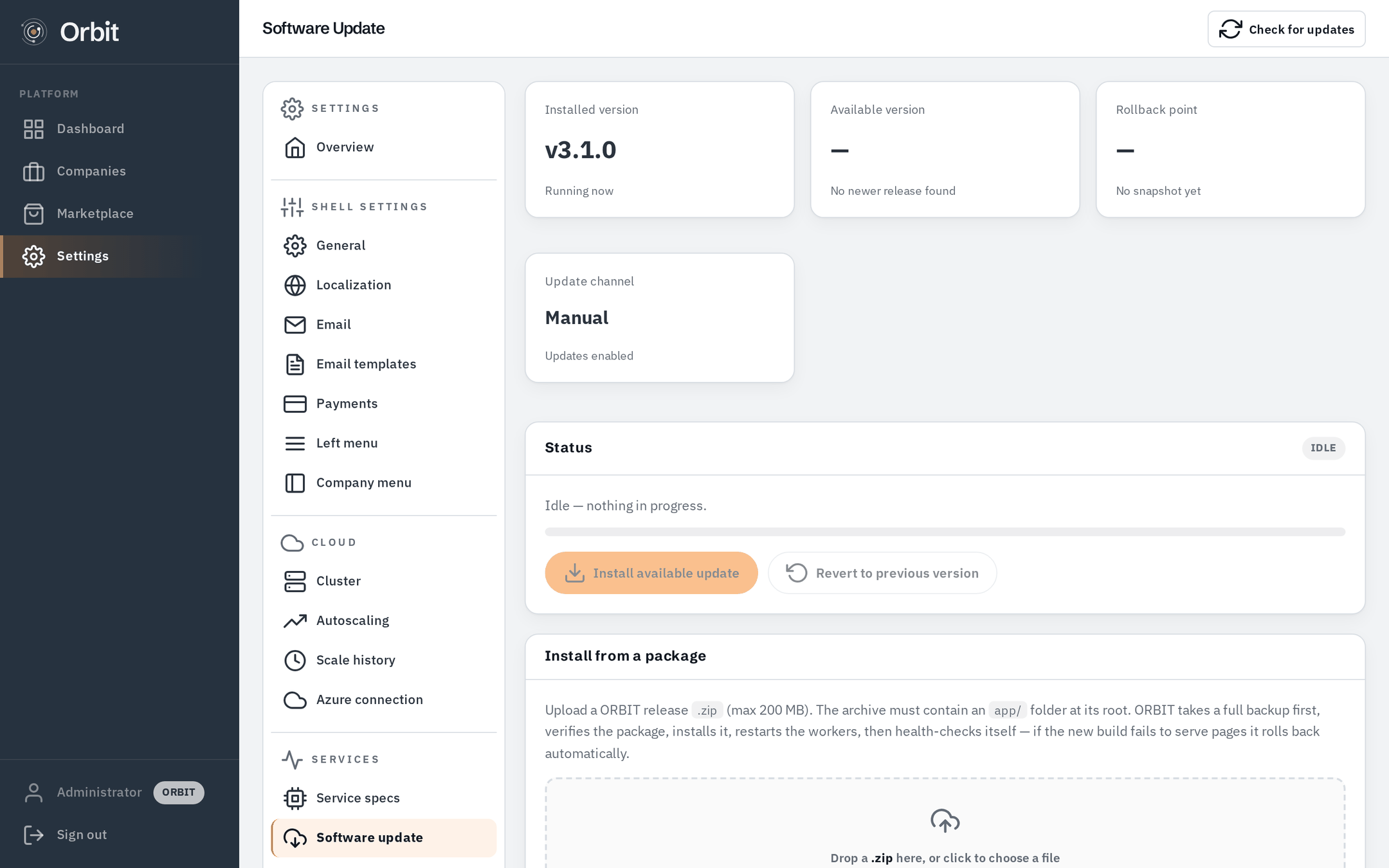
orbit.app/admin/update
Backup and rollback are controls on the screen, not a runbook.
Honest limits
What this page does not claim
Security pages are usually a list of badges. Here is the honest
boundary instead, because you will make a decision based on this
and we would rather you made it with the real information.
We do not claim a formal certification or audit report on this page
We do not claim a published recovery-time guarantee
Where your data physically lives depends on where your
Orbit instance is deployed — if that
matters to you, ask before you commit
Everything stated further up is implemented in the code that ships
in this build. If you need something on this list, say so and you
will get a straight answer about whether it exists today.